Rand Tower
1929, 2020
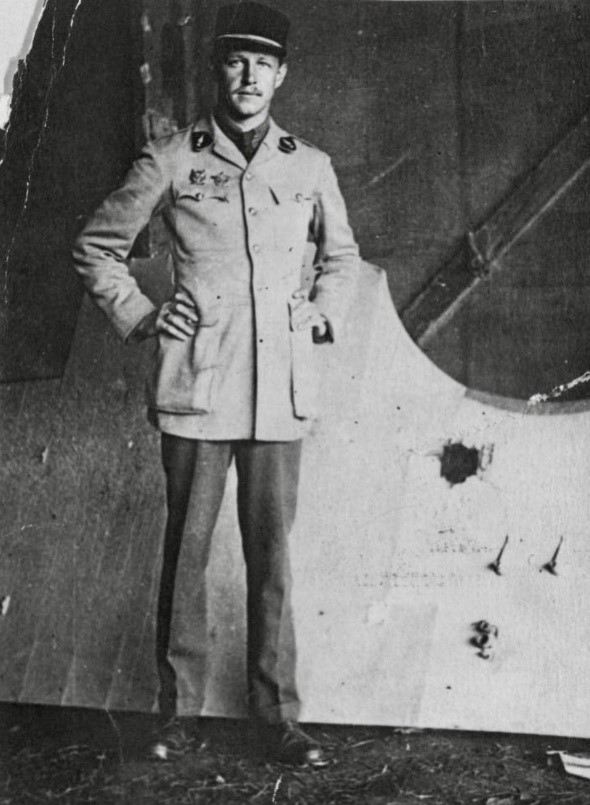
The Rand Tower, 527 Marquette Avenue South, was built by Rufus R. Rand Junior, a World War I aviator who was part of the family that owned the Minneapolis Gas Light Company (Minnegasco), now part of CenterPoint Energy. Per the Star Tribune of June 7, 1928, the tower was planned as a memorial to the Rand family. The Rand Tower was also the fulfillment of Rufus Rand’s dream to develop a building that would be emblematic of the greatness of Minneapolis. The building would be the headquarters of Minneapolis Gas Light Company.
From his time in France with the Flying Corps, Rand developed a love of flying and of the camaraderie inherent in early aviation. During the Corps’ stay in Paris in early 1916, the Americans in the Flying Corps managed to add to their mascot menagerie through the acquisition of Whiskey, a lion cub. Later, they added Soda to round out the pair of cubs that would later be featured in Rand’s building.
When the United States entered the war in 1918, the squadron was transferred to the U.S. Army Air Service. Rand earned the distinguished Croix de Lafayette from the French government for his aeronautical escapades during the war.
After returning from the war, Rufus Rand rejoined his father at the Minneapolis Gas Light Company. They sold all their stock to the American Gas & Power Company and joined that board. From this seat, he became convinced of the future of Minneapolis business and formalized his plans for a business tower downtown.
Rand purchased the site of the old Minneapolis Club for the new building. The Rand Tower was designed by the nationally renowned Chicago-based architecture firm, Holabird and Root. Construction began on September 1, 1928, with the goal of completion in September of 1929. C.C. Haglin & Sons was the contractor. The anticipated cost was $1,750,000.
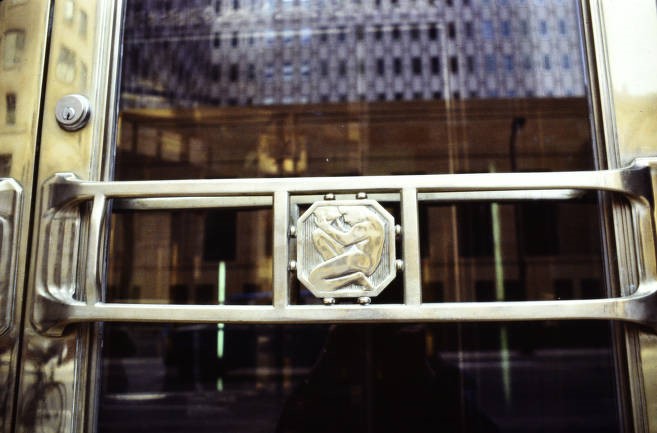
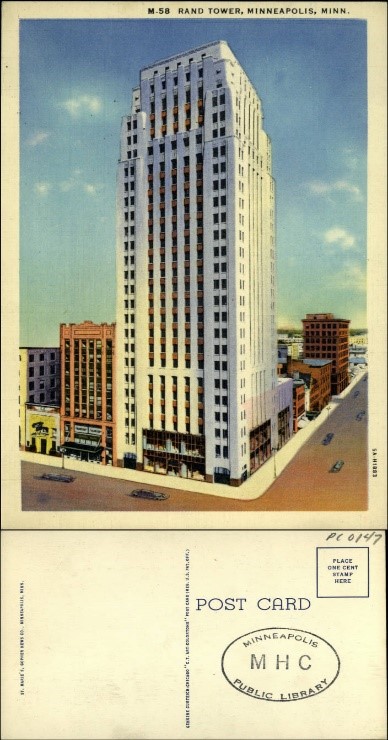
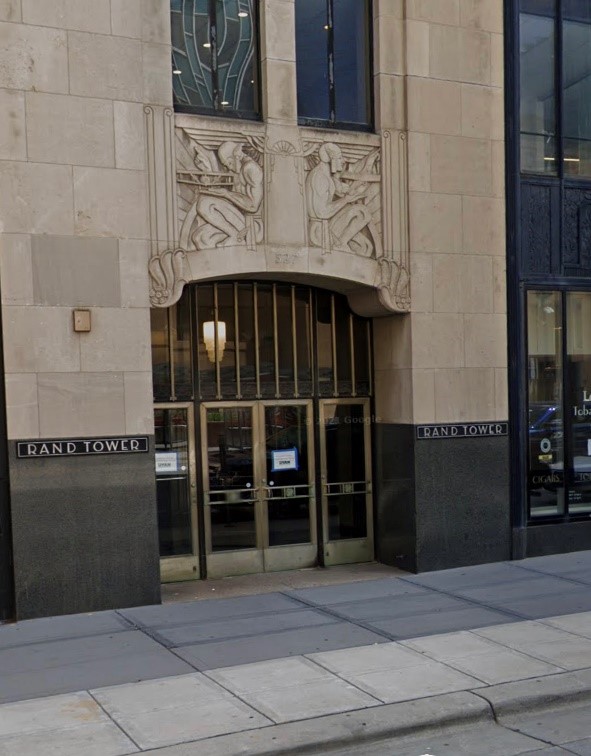
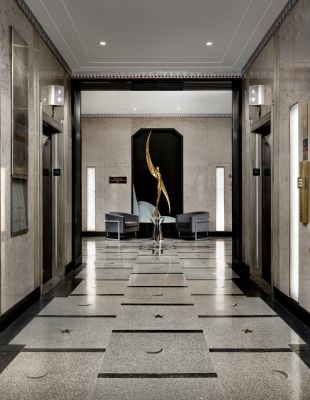
The building stands twenty-six stories tall and boasts Art Deco ornamentation throughout its entirety, featuring a stepped limestone facade. The building, inside and out, encapsulates Rand’s love for aviation. The Wings sculpture is featured in the lobby; there are navigation symbols on the terrazzo floors (compass rose, stars, moon), and a bas-relief of Mercury with biplanes on the façade.
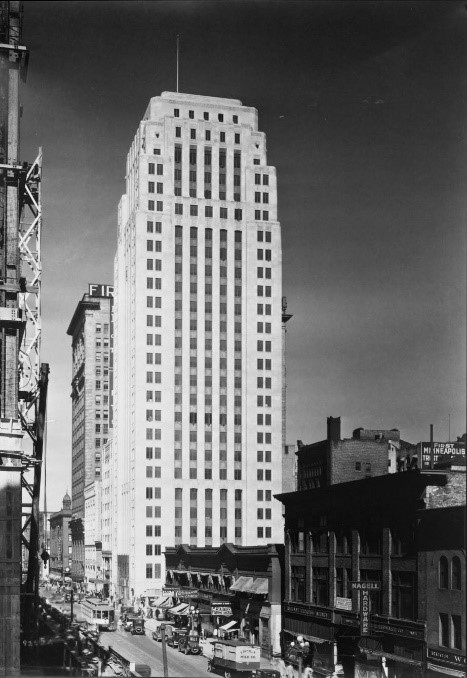
The design of the building’s exterior was partially influenced by recent changes in New York City zoning laws. As buildings grew taller, less sunlight could reach the surrounding streets, forcing buildings to step back as they rose. These zoning laws set the stage for future generations of skyscrapers throughout the country.
The exterior is constructed of cut Indiana Bedford limestone with a base of Quince granite. The tower is a setback skyscraper with the top cut back in sculptural masses. Above the Marquette Avenue entrance, relief sculptures depict Mercury with winged helmets and ankles surrounded by rays of sun with each palm holding biplanes.
Marble walls have recessed panels with tubular lighting covered with etched glass. Elevator doors are highlighted by ornaments. Oskar J.W. Hansen’s sculpture, Wings, is the central focus of the lobby, standing in its niche with its winged arms extended upward and downward.
The interior lobby is one of the most intact examples of Art Moderne in the city. The Rand Tower, the Foshay Tower, and Northwestern Bell Telephone Company Building were the three architectural elements that dominated the Minneapolis skyline until the 1950s.
In 1963 the first permanent overhead walkway was built in downtown Minneapolis. Later the Rand Tower led with extensions, linking the Northstar building with the Rand. This firmly established the financial district at the heart of the Skyway system.
The building was renamed the Dain Tower from the late 1960s when Dain Rauscher occupied the building until the early 1990s when Dain Rauscher moved into new headquarters.
The Rand Tower was added to the National Register of Historic Places in 1994.
In 2017, Maven Real Estate Partners purchased the building for $18.7 million. An additional $86 million renovation was planned to reposition the office tower into a 270-room, four-and-a-half-star hotel called the Rand Tower Hotel.
Custom wallpaper, restored terrazzo floors, and a new $10 million dollar staircase continue the building’s elegant heritage.
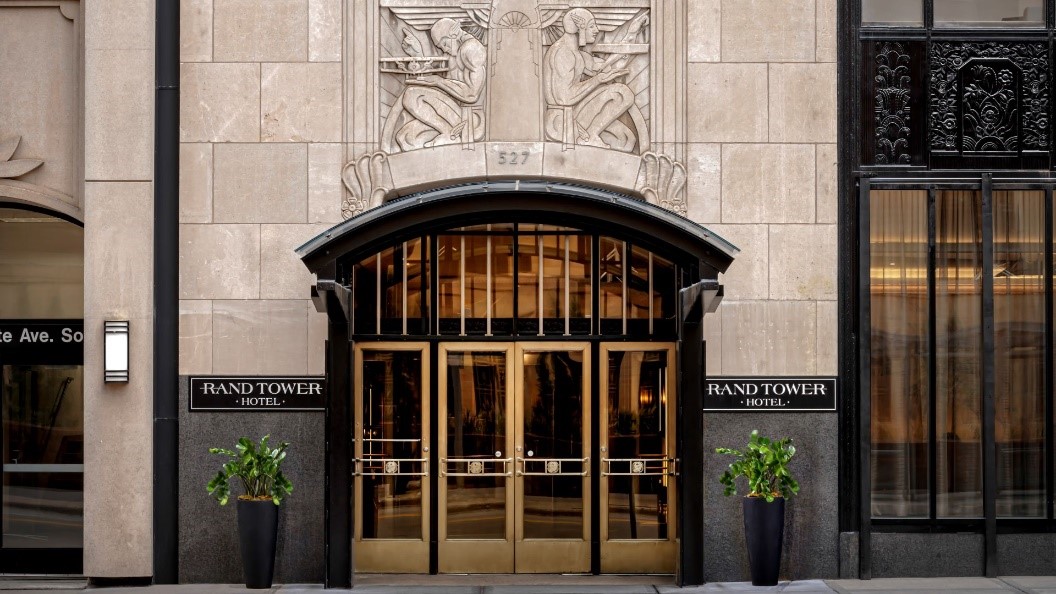
Rand Tower Hotel opened to the public in November 2020. The luxury boutique hotel features two bars, Bar Rufus on the main floor and Miaou Miaou on the fifth floor, and a restaurant, Blondette on the fifth floor beneath a retractable roof.